
欢乐喜剧人
让不同智能体一起干活,难在哪?_我的网站

A | 编者按 工业和信息化部、中央网信办等部门近日联合印发的《关于推动互联网基础资源高质量发展的指导意见》提出,到2035年,我国成为全球互联网基础领域重要创新策源地和引领者。
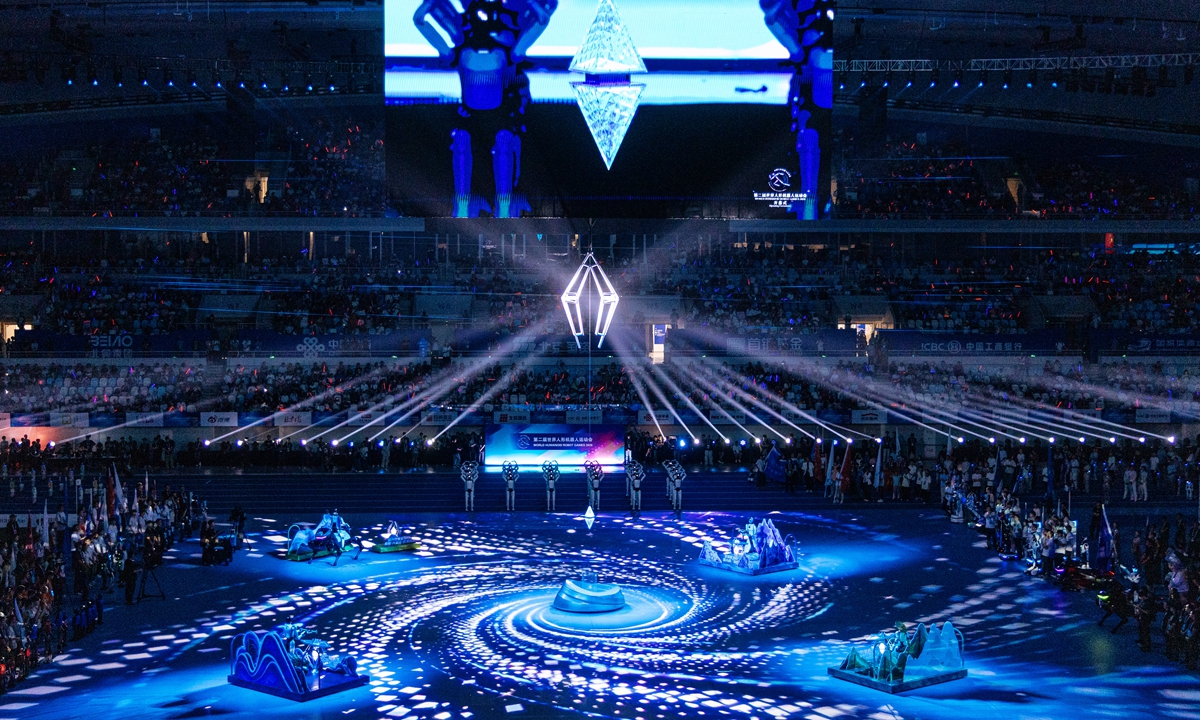
The lights went down inside the National Speed Skating Oval. A humanoid robot riding on a robotic horse, lifted a bow, drew back the string and let the arrow fly.
The arrow found its mark, and the “Zhixin,” or intelligence chip — this competition’s equivalent to the Olympic flame — lit up above the arena. The venue erupted in cheers.
With that, the 2nd World Humanoid Robot Games opened on Saturday at the Beijing venue better known as the “Ice Ribbon” — the capital’s second robotics showcase in a week, following the 2026 World Robot Conference, which opened on August 19.
The opening ceremony began with demonstrations of the 100-meter sprint and the standing high jump. In the sprint, a humanoid robot clocked 9.39 seconds — faster than the men's 100-meter world record of 9.58 seconds set by Jamaican sprint legend Usain Bolt. In the high jump, a humanoid robot reached 288.43 centimeters. Both marks were set by the Tien Kung Ultra humanoid robot by Beijing-based X-Humanoid. Table tennis, tennis, football and other events were then demonstrated jointly by elite human athletes and robots.
The parade of international delegations and robot contingents followed, including formations of humanoid robots from Booster Robotics, Galbot and Noetix Robotics. The robots performed drills as they marched, all of it done autonomously with no remote control.
The X-Humanoid fielded a 50-strong contingent of its Tien Kung 3.0 robots. Tien Kung 3.0 also served as the only robot flag bearer of the games, marching at the head of all contingents while waving the games flag, and it is also the humanoid robot archer who lighted the “Zhixin”, the company told the Global Times.
More than a thousand robots appeared over the course of the ceremony, in a series of joint performances with humans — an opening overture played by humanoid robot musicians alongside a human orchestra, and segments with pop singers, with the judges of the dance events taking the floor themselves, and with children.
Taishan Sports, the Shandong-based official equipment supplier of the games, provided the running tracks, the artificial turf for the football pitches, the floor surfacing for events including the long jump, high jump and weightlifting, and the impact mats that slow the robots down at the end of the sprint lanes.
"Robots are very heavy, and what they need from a surface in terms of hardness and friction is not what a human runner needs, so we adjusted the material formula specifically," Man Fangfang, the vice director of the company, told the Global Times at the venue. The artificial turf was reworked the same way — robots do not play football the way people do, and the turf has to be non-slip and antistatic.
The company spent months talking to the competing teams and retesting the gear before the games. Taishan Sports has supplied equipment to eight Olympic Games and more than 3,000 sporting events, "but this is our first time serving robot games," she said.
China's robotics industry is growing fast and robots are moving into every sector, while the sports industry has always lent itself to crossover with other fields, Man said, adding that the company wants to use the games to work out what equipment suits robots and to develop more of it.
Compared with the first edition, the second games have expanded in both scale and quality. A total of 666 teams and 2,056 robots from 16 countries across six continents are competing, with the number of teams up 138 percent from the first edition and the number of robots quadrupling, according to CCTV.
Competition events have doubled from 26 to 51, while the number of matches has more than doubled from 487 to 1,301. More combative and spectator-friendly events such as martial arts and dance have been added to the competitive program.
Notably, the second games set stricter autonomy requirements for the robots. Except for the 100-meter and 400-meter obstacle races, all track events and other competitive events must be completed by robots fully autonomously. In scenario-based events, a task completed fully autonomously carries a final score weighting coefficient of 1, while one completed by remote control carries only 0.5, per CCTV.
Analysts said the higher bar on autonomy is in line with the industry’s development goal of having robots complete tasks without human operation.
。针对当前国内互联网基础资源高质量发展面临的挑战,本报聚焦智能体互联网络基础设施建设、韧性域名系统体系化构建这两大关键议题,深入剖析行业痛点,探寻破局路径。 “帮我看一下手机日历中的出差计划,根据行程订好机票、出租车,再安排一下用餐。”执行用户发送给AI助手的这样一句指令,离不开多个跨平台智能体的协同合作。当前,智能体互联互通水平快速提升,正推动智能体技术从单点应用向网络化协同发展跃升。 不久前印发的《关于推动互联网基础资源高质量发展的指导意见》提出,探索构建具备统一通信协议、数据交互标准和接口规范的智能体互联网络基础设施。作为AI时代最具变革性的技术形态之一,智能体的互信、互联、互操作水平正深刻影响着AI技术的落地效果与产业价值释放。 然而,构建智能体互联网络仍面临多重现实障碍。让不同智能体一起干活,究竟难在哪儿? 互联要闯“五道关” “单体智能解决的是‘一个智能体会不会做事’,智能体互联网解决的是‘不同智能体能不能一起把事做成’。”中国信息通信研究院(以下简称“中国信通院”)工业互联网与物联网研究所互联网研究部主任李炳奇告诉记者,当前,AI正从回答问题、生成内容,进一步走向理解目标、调用工具和执行任务。但单个智能体再强,也会受到知识、数据、工具和权限边界的限制,智能体数量的增加,并不会自然形成群体智能。面向企业经营、产业链协同、城市治理等复杂任务,需要不同平台、不同组织的专业智能体能够相互发现、确认身份、调用能力并协同执行。 要实现这一目标,首先要解决智能体之间“找不到、认不准、连不通、协同难、责任不清”的问题,从而构建开放、可信、可治理的网络基础设施。“智能体互联网就是让分散的智能能力能够按需组合,推动AI从单点应用迈向网络化协同。”李炳奇说。

B | 前景虽广,但智能体互联网建设并不是简单地把现有接口再封装一遍,而是要建立一套面向自主智能主体的网络机制。 李炳奇认为,在技术方面,智能体互联网发展壮大至少要闯“五道关”。第一是“身份关”,要解决智能体是谁、属于谁、具有什么权限等问题,为每个智能体建立唯一标识、可信认证和动态授权机制。第二是“发现关”,要用机器可理解的方式描述智能体的能力、输入输出和服务条件,让智能体能够根据任务找到合适的合作对象。第三是“互通关”,要解决不同模型、框架和平台之间协议及语义不一致的问题,统一任务表达、状态管理和上下文传递。第四是“协同关”,要支持任务拆解、能力编排、过程反馈、异常处理和服务质量保障。第五是“安全关”,要把最小权限、加密传输、运行隔离、行为审计、风险监测和责任追溯嵌入全过程,最终实现能力可发现、身份可认证、任务可协同、行为可管控、责任可追溯,并且在海量智能体接入的情况下仍然可靠、稳定、可扩展。 目前,中国信通院正联合产业各方,围绕总体架构、身份标识、能力发现、互联协议和安全治理等开展研究,推进标准研制、试验验证和国际交流。其中,中国信通院子公司北京泰尔英福科技有限公司正围绕身份、注册、发现、互联、安全五大环节,积极参与各类产品设计与技术验证工作,在分布式数字身份、智能体标识注册、能力发现匹配、跨域可信互联和分层安全治理等方面打通关键链路,推动不同平台智能体实现互认互通。

C | 技术标准有待统一 尽管当下绝大多数智能体均具备调用外部工具、对接业务系统的接口能力,但实现跨厂商、跨领域、跨技术栈的智能体互联,仍面临多重瓶颈。 就底层技术标准而言,当前行业内A2A、MCP、ANP、AIP等多种交互协议并行探索,异构智能体底层技术栈、语义表达体系各不相同,缺乏有全行业共识的统一通信规范与语义对齐机制。大量智能体处于“各自为战”的孤岛状态,即便能连上外部系统,也难以与其他生态的智能体开展稳定、高效的自主协作,跨生态适配成本居高不下。 李炳奇说,目前,智能体互联仍处在标准形成期,企业协议、开源项目和国际标准同时存在。

D | 例如,从产业侧看,MCP主要解决智能体与数据、工具和外部系统的连接,A2A主要解决智能体之间的发现、通信和任务协作,两者具有较强互补性。A2A已由Linux基金会托管并发布1.0稳定版本,MCP也已纳入Linux基金会旗下的Agentic AI Foundation,这说明相关协议正在从企业主导的技术方案,逐步走向开放、社区化和相对中立的治理模式。 从国际标准组织看,互联网工程任务组(IETF)已围绕智能体发现与调用、身份管理、任务协同和跨域互操作等形成一批互联网草案;全球移动通信标准制定国际组织第三代合作伙伴计划(3GPP)也开始从6G体系角度研究智能体的注册、发现、鉴权和通信。

E | 但值得注意的是,相关互联网草案仍属于“工作中的提案”,尚不等同于正式国际标准。 “总体来看,当前技术路线和协议仍较为分散,跨平台互操作所需要的身份、发现、寻址和信任等公共层能力还不完善。”李炳奇说,此外,智能体具有较强的自主性,对错误调用、权限越界、数据泄露和责任认定等问题,需要建立不同于传统软件的新型治理机制。

F | 同时,测试评估、服务质量、成本结算和生态运营模式也尚未成熟。 落地场景仍需沉淀 找到应用场景是推动智能体互联网进一步壮大的关键。

G | 当前,对于智能体互联网的场景挖掘尚显不足,需要多智能体相互协作,尤其是跨平台协作的刚需场景较少。大多数场景仍停留在单体智能体或企业内部编排层面,真正跨组织协同、能够形成明确投入产出比的场景还不够多。

H | “智能体互联网的发展需要兼顾技术攻关和场景落地两方面。”北京泰尔英福科技有限公司智能体创新部副总监胡嘉明认为,智能体作为自主性更强、风险更高的新型网络交互载体,应当有身份安全、互联安全的制度保障。同时,要充分发挥我国丰富的应用场景潜力,加速探索智能体互联网赋能产业的新场景、新服务、新模式,通过场景验证和市场筛选,让可复制、可持续的智能体互联网应用场景逐步沉淀。 胡嘉明介绍,以智能体互联网示范网络为工作基础,北京泰尔英福科技有限公司研发了可支持多智能体协作的智能体工厂、智能体公共服务平台、供应链协同平台和产业供需对接平台,在智能体编排调度、政务民生服务接入、上下游跨组织协同和企业供需智能匹配等场景开展试点验证、产业服务。 “既不能等到所有标准完全成熟后再行动,也不能在标准缺位的情况下盲目铺开。”李炳奇建议,应坚持“标准先行、场景牵引、试验验证、治理同步、开放合作”理念,先建设试验网络,构建身份、发现、互联等公共能力,再选择制造、商贸、政务等高价值场景开展小切口、深流程验证;同时完善检测认证、审计溯源和风险处置机制,积极参与国际标准和开源生态建设,逐步形成开放互联、可信可控、可持续运营的智能体互联网产业生态。

I | (科技日报 本报记者 都 芃) 【编辑:刘欢】。

J |
Current article:http://ktp.focuolequzenkedenchaoruaxing.pics/5rgl26/ic49h9.html
Published on:22:38:47